
Budget Challenges are Significant | We Must Act
Did you know that nearly 90% of our state funding goes toward salaries? Recently, Assemblymember Alex Lee at Brier and Senator Aisha Wahab at Irvington visited our schools to meet with leadership staff and brainstorm ways to balance funding models for districts like FUSD, which operate with a lower per-pupil allocation.
Thanks to the hosting schools who welcomed the group into their classrooms and meeting areas. Two trustees, the superintendent, the assistant superintendent, and budget director discussed with state lawmakers the challenge of doing so much with significantly less and explored creative solutions together. A huge thank you to our legislators for coming onsite and sharing insights on processes in Sacramento. These meetings with our legislators highlighted flaws we believe exist in the Local Control Funding Formula (LCFF) that are affecting our district’s level of funding.
Budget challenges are significant, but failing to act will keep us stuck in the same under funded position.
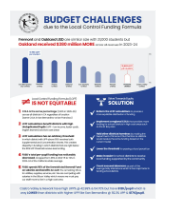
Key challenges with LCFF:
- Cost-of-living adjustments (COLA) are the same across all districts (2.30% in 2025-26), regardless of geographical location, reducing buying power for high-cost areas like nearly all of the East Bay.
- Districts with high percentages of unduplicated pupils (UPP) and low local costs benefit more. And they absolutely should. If a district has an abundance of students who need additional services they should have additional funding however;
- LCFF has an arbitrary 55% UPP threshold for the Concentration Grant, leaving districts just below the threshold underfunded. And FUSD has schools that exceed 55% UPP but because our district as a whole hovers at about 30% we do not benefit from the funding despite having students who desperately need additional services.
- Property taxes are not sufficient to be considered "community funded" like neighboring districts on the Peninsula such as Palo Alto, San Mateo Union, and Burlingame.
- Inflation is rising faster than COLA, leading to annual budget reductions.
- 85–90% of our budget is personnel, so cuts often mean staff reductions, higher class sizes, and the loss of programs and services, affecting student experiences. In the last 10 years we have cut approximately $50 million. There is just not much left to cut and when cutting impacts students it makes no sense to educators.
 Why this matters:
The mechanics of LCFF deprives moderate districts like FUSD, not high enough UPP for Concentration Grants, not high enough "community funding" to compensate, and inflation outpacing COLA.
Proposed solutions:
- Reform LCFF to distribute funding more evenly
- Implement regional COLA adjustments for high-cost areas.
- Adjust Concentration Grant thresholds or redistribute by school not whole districts, this means if school X has a UPP count over 55% the school will receive additional funds even if the district does not meet the threshold.
- Consider other measures such as counting excused absences in Average Daily Attendance and lowering thresholds for passing local parcel taxes.
This work is urgent. Fremont Unified is not a community-funded district like some neighboring districts, meaning we must be strategic to ensure our students receive fair funding support. We encourage you to watch this video to see the impact of state funded versus community funded districts. (The 20 minute video is on YouTube based on the same issues in Santa Clara County, the wording “Code Red” is used to describe a matter of significant concern, and should not be interpreted as indicating any specific affiliation). Imagine what we could accomplish with double our current per-pupil funding.
FUSD cannot do this work alone. We formed a coalition with similarly underfunded unified districts including Alameda, Castro Valley, Dublin, Livermore, Newark, Pleasanton, and San Ramon Valley, to advocate for necessary changes.
Presentation Slides
Learning Policy Institute Fact Sheet on LCFF: Next Steps
From last year Balanced Budget Frequently Asked Questions (FAQ)
Thank you for staying informed about this critical topic. Your support and participation are essential for our students.